

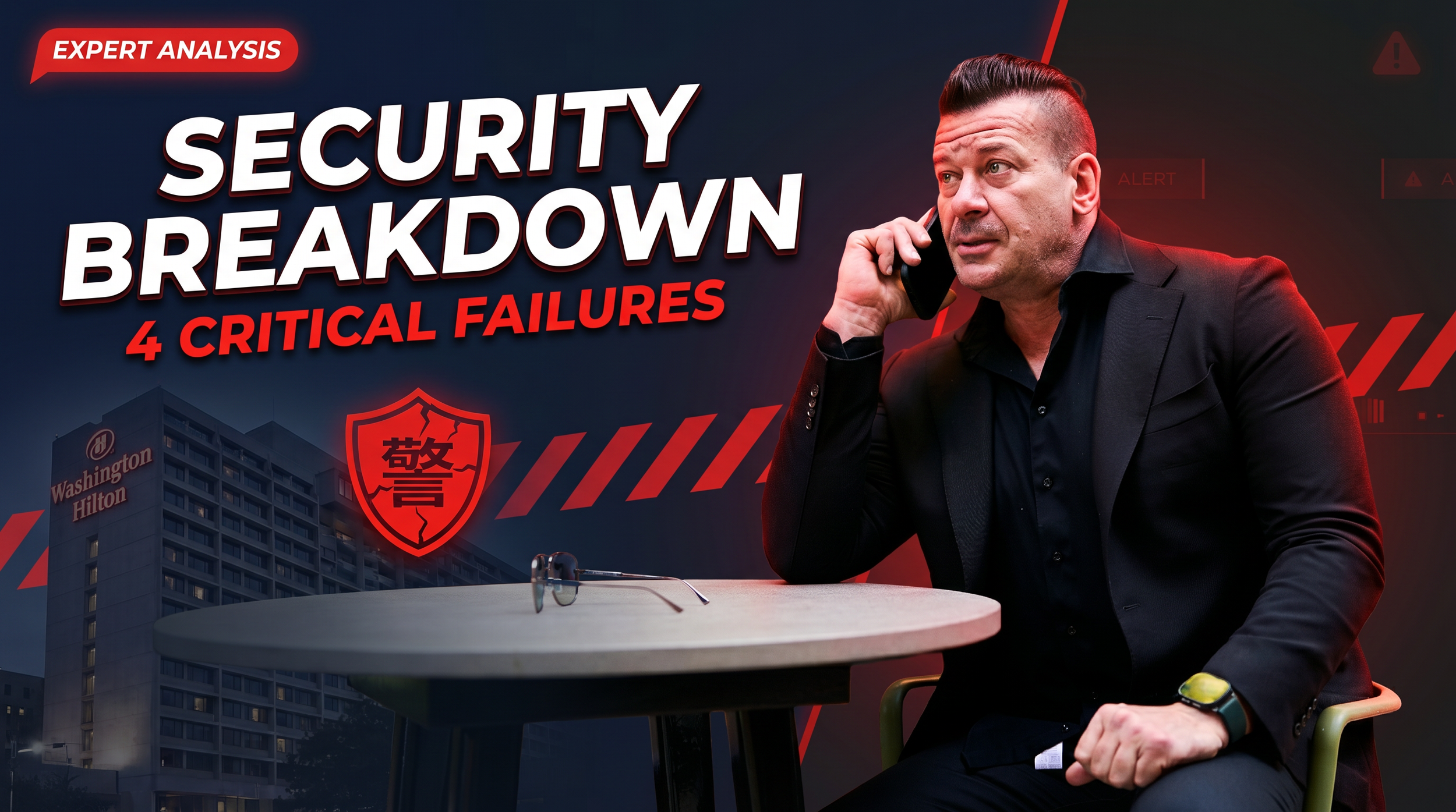
Presidential Security Breakdown: Expert Analysis of the Latest Assassination Attempt
Expert analysis reveals four critical failures in Secret Service protection during the latest attack on President Trump
Another attempt on the president's life has raised serious questions about the effectiveness of current protective protocols. While President Trump praised the Secret Service for stopping the attack, the fact that an armed individual reached the ballroom entrance of the Washington Hilton the infamous site of the 1981 Reagan assassination attempt reveals troubling vulnerabilities in our highest levels of security.
In this episode, I sit down with threat management expert and author of The Safety Trap, Spencer Coursen, to conduct a comprehensive after-action analysis of what went wrong and how future attacks can be prevented.
The Four Critical Failures
Coursen identifies four fundamental breakdowns that allowed this attack to progress as far as it did:
1. Leakage: Missed Warning Signs
Leakage refers to any communication of intent, ideation, or grievance that precedes an act of violence. It's one of the most predictive pre-incident indicators available to protective intelligence teams. In this case, the attacker authored a manifesto, and his family made calls to police before the attack, yet these critical signals were either missed, dismissed, or were never connected into actionable intelligence.
"What was missed? What was dismissed? What connections were not connected?" Coursen asks. The failure to aggregate and analyze these warning signs represents a fundamental breakdown in protective intelligence.
2. Target Selection: Perceived Vulnerability
The single most influential factor in target selection is likelihood of success. The attacker's manifesto explicitly referenced the lack of security and clear attack pathways that made this event attractive. He conducted extensive research, including virtual 360-degree tours of the hotel available online, allowing him to map out elevator lobbies, stairwells, and routes to the ballroom with precision.
"Anything that we can do to mitigate that likelihood of success will ensure the future certainty of safety," Coursen emphasizes.
3. Defense in Depth: The Protective Envelope Collapsed
When you have the President, Vice President, Joint Chiefs, members of Congress, and the line of succession in one location, you need concentric rings of security protecting the entire venue not just the event space. The Washington Hilton presents unique challenges: it hosts both event attendees and regular hotel guests, yet the entire facility was not secured.
The attacker was able to check into the hotel the night before with multiple weapons, including a pistol, shotgun loaded with buckshot, and knives. He circumvented TSA screening by taking trains from his origin to Chicago and then to Washington, D.C. Video footage shows him lingering in the lobby, waiting for security personnel to relax their vigilance after the event began, then rushing through an understaffed magnetometer checkpoint.
"You want to have protective entities outside there so that you can identify behavioral anomalies or self-identifying behaviors of someone who may be on the pathway to violence," Coursen explains.
4. Response Over Prevention: The Secret Service Paradox
The Secret Service excels at threat response getting the principal "off the X" under duress. We saw this capability in Butler, Pennsylvania, and again at this event. However, the agency continues to fall into the trap of relying on reactive measures rather than preventative protocols.
Coursen points to several response failures in this incident:
A full 10-second delay before any protective package surrounded the President after shots were fired
Another 10 seconds elapsed before the President began to be moved inefficiently at that
The President himself influenced the timing of his evacuation, saying he "wanted to see what was going on"
Physical mismatches between protectors and the protectee, with agents unable to effectively lift and move the President
Vice President Vance was evacuated before President Trump
"The person who is under duress should never be a decision maker," Coursen states. "You cannot have your protectors be smaller than their protectee."
The Five D's of Protection
Effective protective protocols require what Coursen calls "the Five D's": Deter, Detect, Deny, Delay, and Defend. Current Secret Service operations focus heavily on the last two delay and defend which are reactive rather than preventative.
"When you take the first three out and you're left with just delaying and defending, you want to really reimagine your protective protocol so that it is one of a preventative action rather than a reactive one," Coursen explains.
The first three D's deter, detect, and deny are where security programs succeed or fail. If someone can circumvent deterrence and detection, the remaining defensive measures become desperate last stands rather than layers of a comprehensive security architecture.
The Red Team Scenario
Perhaps most chilling is Coursen's assessment of what could have happened if this were a coordinated professional attack rather than a lone actor. The video footage reveals a critical vulnerability: when the attacker rushed the magnetometer, every agent abandoned their post to pursue him, leaving the checkpoint completely unguarded.
"This is what we would call in the military “ambush relief syndrome," Coursen explains. "You send basically a probe in, someone you expect to be detained to capture the attention of everyone who is supposed to be securing that event, and then the follow-on forces come through."
If a hostile nation had deployed a professional team what security professionals call a "red team" the outcome could have been catastrophic. The term "red team" originated with Richard Marcinko's SEAL Team 6 operations testing nuclear silo security by simulating Russian attacks.
The Historic Hinckley Hilton
The Washington Hilton carries a dark legacy as the site of the 1981 assassination attempt on President Ronald Reagan by John Hinckley Jr. The venue is known among security professionals as the "Hinckley Hilton" and has specific protective infrastructure built into it, including a secure arrival area for the President and a hardened room behind event stages.
Yet this historic significance and existing infrastructure were insufficient to prevent another attacker from reaching the same venue with weapons and intent to kill. The institutional memory of that attack should have elevated security protocols, not created complacency.
Recommendations for Future Protection
Coursen offers clear guidance for improving presidential protection:
Comprehensive venue security: Secure the entire facility, not just event spaces, with behavioral monitoring throughout
Enhanced protective intelligence: Cross-reference hotel guests against event attendees using available data analytics
Physical matching: Ensure protective agents physically exceed the protectee's size and strength
Eliminate principal decision-making: The person under threat never decides evacuation timing
Post-event vigilance: Maintain maximum alertness after events conclude, when relaxation creates vulnerability
Integrated threat assessment: Connect online communications, family warnings, and behavioral indicators into actionable intelligence
Focus on the first three D's: Prioritize deterrence, detection, and denial over reactive defense
The Bottom Line
"Every protective organization who is responsible for ensuring the certainty of their protectee's safety really needs to take a hard look at just how effective your deterrence and your detection factors are," Coursen warns. "Because if someone is able to circumvent those two D's, the next three D's are deny, delay, and defend. And that's when you pivot from a preventative model to a reactive model."
His final assessment is stark: "In any protective entity, if you are relying on how good your reaction is, you've already lost."
This attempted assassination the latest in a series of threats against President Trump demonstrates that reactive excellence is insufficient. The Secret Service must reimagine its protective protocols to emphasize prevention over response, intelligence over firepower, and comprehensive security architecture over last-ditch heroics.
The American people deserve to know that the President, Vice President, and line of succession are protected by systems designed to prevent attacks, not merely respond to them. Until that fundamental shift occurs, we remain vulnerable to not just lone actors, but coordinated professional teams that could exploit the same weaknesses revealed in this attack.
Watch the full episode for detailed analysis of the security footage, discussion of the attacker's manifesto, and Spencer Coursen's complete breakdown of protective protocol failures. Subscribe to stay updated on critical security and threat management insights.