
You Already Said Yes – How Predators Test Your Boundaries Before Violence
Predators rarely begin with obvious danger. They start with small, subtle violations of your boundaries that feel “too minor” to address. This article breaks down how predators test your resistance, why agreeability can be exploitable, and how clear boundaries can protect you long before violence is ever on the table.
Predators Don’t Start With Violence
A lot of people think danger begins at the moment of violence. In reality, most predators start with something far more subtle: permission. Not explicit permission, but behavioral permission—boundaries crossed, hesitations ignored, and “no” softened into politeness. A boundary without a consequence is just a preference, and that’s exactly what predatory people look for.
Real-world predation often relies less on force and more on compliance. Before anything escalates, predators are asking one core question: Will your boundaries hold, especially under stress?
What Predators Are Really Looking For: Access and Compliance
Predators look for access, not chaos. One of the biggest myths about predators is that they’re impulsive and reckless. Many are patient, observant, socially intelligent, and highly adaptive to their environment. The people easiest to manipulate are often those with the deepest desire to be liked.
Most predators don’t start big—they start small. Can they step a little too close? Can they make you uncomfortable without consequence? Can they use your desire to be liked against you? Each micro interaction helps them assess how much resistance they’ll face if they escalate.
Subtle Boundary Tests Most People Miss
Boundary testing is usually quiet and incremental. The more experienced the predator, the less obvious the behavior will be. It often looks like everyday social interaction, which is why so many people dismiss it. Common boundary tests include:
Standing just a little too close
Touching when it’s not necessary
Ignoring a small “no” or hesitation
Asking questions that feel intrusive
Creating fast, forced intimacy
Oversharing to pull you into their confidence
Positioning you into isolation or situations where saying no feels awkward
Sometimes it comes wrapped in charm or humor. Other times it shows up as vulnerability or pressure. The objective is always the same: discover whether your boundaries will bend, break, or hold.
Why Agreeability Can Quietly Increase Your Vulnerability
Agreeability itself is not weakness. Highly agreeable people are often empathetic, cooperative, and emotionally intelligent—these are strengths. The vulnerability appears when agreeability goes unchecked.
If someone is conditioned to prioritize being liked, avoiding conflict, keeping the peace, and protecting other people’s feelings over their own safety, predators notice quickly. They recognize that agreeable people hesitate to be direct, to create discomfort, or to say “no” clearly. Many will choose to be uncomfortable rather than risk being perceived as rude, and predatory individuals exploit that hesitation.
The Power of Productive Disagreeability
There is real power in healthy disagreeability. This doesn’t mean becoming aggressive; it means becoming clear. Productive disagreeability looks like:
The willingness to say “no” without apology
The willingness to create friction when a boundary is crossed
The willingness to enforce limits, even when it feels socially awkward
Some of the safest people are not the strongest physically—they’re simply the hardest to manipulate. They leave early, push back on questionable behavior, and disengage without feeling the need to justify themselves. Because resistance increases cost, predators usually seek the path of least resistance. When you raise the cost of targeting you, they are more likely to move on.
How Social Conditioning Makes Us Easier to Target
A big part of this vulnerability comes from social conditioning. Many of us were raised to:
Be nice and accommodating
Avoid “making a scene”
Not hurt anyone’s feelings
Give people the benefit of the doubt
Predators exploit these scripts consistently. A stranger ignores your “no.” A coworker pushes a personal boundary. A date applies pressure. Someone keeps stepping into your space.
A healthy person notices discomfort and adjusts. A predatory person often does the opposite—they escalate, testing whether your boundary will weaken once you feel pressured, embarrassed, or obligated.
Discomfort Is Data: Trusting Your Intuition
Discomfort is data. It is not proof of danger, but it is a signal worth paying attention to. The key insight is this: the behavior itself is often not the point—the reaction is.
If someone crosses a line and nothing happens, they learn something about you.
If they pressure you and you apologize, they learn something else.
If you minimize your own discomfort to preserve harmony, they learn that your boundaries are negotiable.
Compliance compounds. Each unchallenged moment becomes a stepping stone toward escalation. Danger doesn’t begin at the moment of violence; it begins at the moment someone realizes your boundaries can be pushed without consequence.
Clear Boundaries, Clear Communication, Clear Self-Respect
The goal here is not paranoia; it’s clarity. Clear boundaries, clear communication, and clear self-respect are some of the most powerful safety tools you have. You don’t need a speech and you don’t need permission to use them.
“No” is a complete sentence. One of the most important skills you can develop is the ability to tolerate social discomfort—those tense, awkward moments where you choose safety over likability. Many dangerous situations escalate when someone ignores their instincts to avoid offending another person.
Assertiveness Without Aggression: Phrases That Protect You
Assertiveness does not require aggression. Simple, calm statements often work best, especially early in an interaction. Examples include:
“I’m not comfortable with that.”
“Please step back.”
“I said no.”
“I’m leaving.”
“No.”
These phrases create friction and signal that your boundaries are real, not theoretical. The more friction you create, the more you disrupt a predator’s momentum and force them to reassess whether you are worth the effort.
Boundary Testing as a Pre‑Incident Indicator
Threat management isn’t just about responding to violence—it’s about recognizing the patterns that lead to violence before they’re allowed to unfold. Boundary testing is often one of the earliest pre-incident indicators.
Not every rude person is dangerous, but repeated disregard for your boundaries, especially when it escalates, should always get your attention. Healthy people respect boundaries. Predators study them.
Choosing Safety Over Likability
The goal of this work is not to burden you with fear but to empower you to become harder to manipulate. When you understand how predatory behavior unfolds, you can trust your instincts, recognize patterns, and respond earlier.
Sometimes protecting yourself means being willing to disappoint someone. Safety and likability are not always aligned. When you’re forced to choose, choose safety. You may never know what you prevented—but that’s the point.
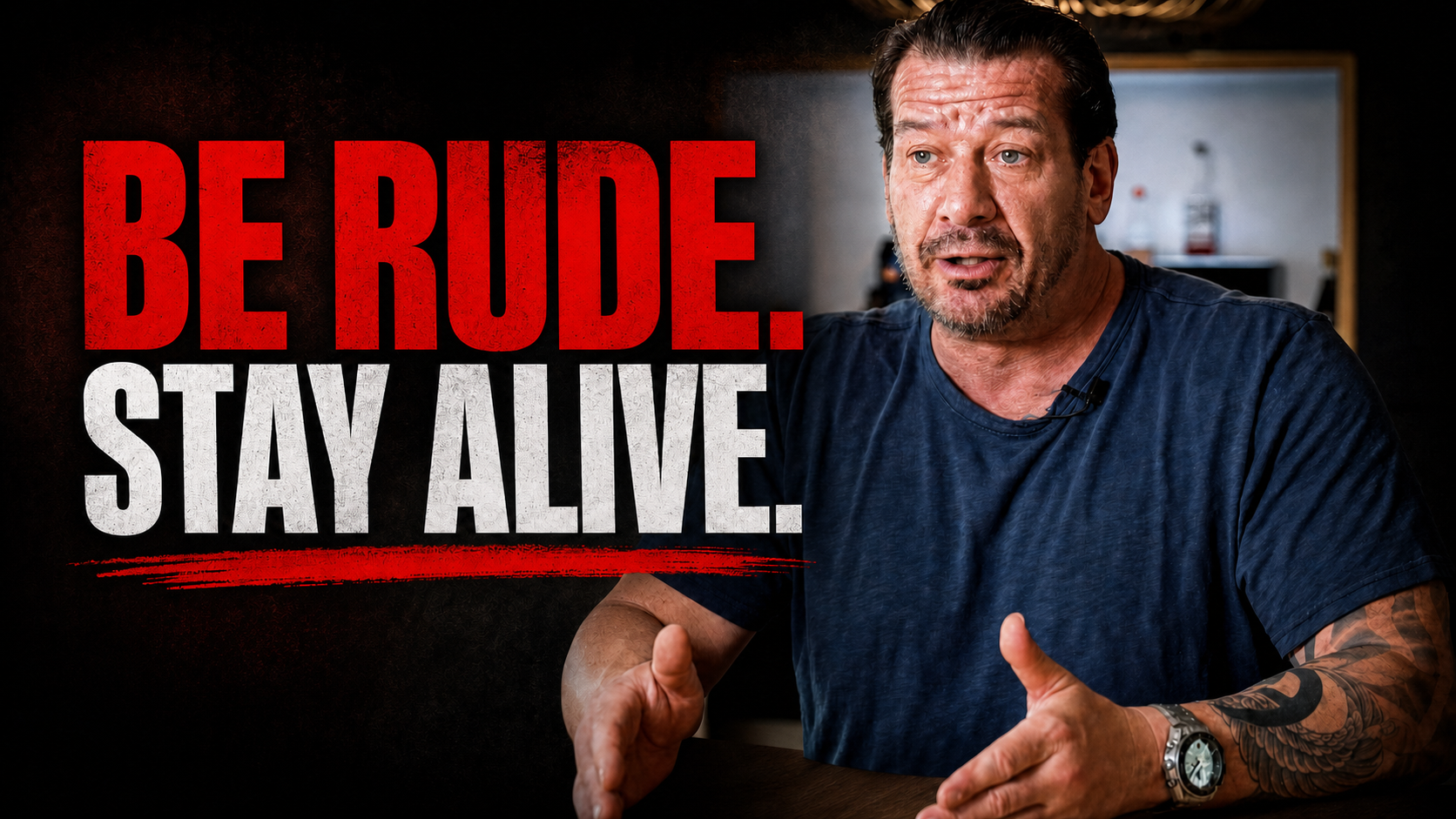
Be Rude. Stay Alive.
“Being nice” shouldn’t cost you your safety. This post breaks down why politeness can be dangerous, how to trust your intuition, and how non‑negotiable boundaries become your first line of defense.
Being polite is a courtesy. Protecting yourself is a priority.
From the time many women are little girls, they’re taught to smile, to be agreeable, to avoid “making a scene.” Say yes. Be helpful. Don’t be rude. Even when every internal alarm bell is ringing, that social conditioning can override instinct and create a dangerous hesitation right when fast action is required.
This isn’t about becoming hostile or cold. It’s about recognizing that your safety will never be worth less than someone else’s opinion of your manners.
In this post, I want to share three critical safety lessons: why being nice can become dangerous, how trusting your gut is backed by science—not superstition—and how setting non‑negotiable boundaries becomes your first line of defense.
When Being Nice Becomes Dangerous
Think about these moments:
A stranger asks you to help load something into their car.
Someone you don’t know calls your name in a dark parking lot.
You feel like you’re being followed, but you don’t want to “overreact.”
Your instinct whispers, “Get out of here.”
Your conditioning replies, “Don’t be mean.”
That gap between instinct and action is where danger lives.
People who intend harm are not looking for the strongest target; they’re looking for the easiest one. They look for compliance, not confrontation. If you’ve been trained your whole life to avoid conflict at all costs, you can appear—without even realizing it—like a more promising target.
Giving yourself permission to be “rude” when your safety is at stake is a radical act of self‑protection. You do not owe anyone:
Your time
Your help
Your attention
Your body
Especially not when something feels off.
“Be rude. Stay alive.” is not about being unkind. It’s about recognizing a simple truth: strangers are not entitled to your comfort, but you are entitled to get home safe.
The Science of Trusting Your Gut
Women’s intuition is often treated like a joke or a cliché. It isn’t. It’s neuroscience.
Your brain is constantly scanning your environment, taking in far more information than your conscious mind can process in real time. Microexpressions, subtle tone changes, shifts in body language, environmental anomalies—your nervous system notices these signals before you can put words to them.
That “weird feeling” in your stomach?
The hair standing up on your neck?
The sudden urge to create distance?
That’s your brain alerting you to a pattern that doesn’t match what “safe” usually looks like.
Here’s what makes many women more vulnerable: they’re repeatedly told they’re “too sensitive,” “too dramatic,” or “paranoid” for listening to those signals. Over time, they learn to doubt themselves. They feel pressure to stay, to stay quiet, to stay polite—until it’s too late.
You do not need a court‑approved level of evidence to walk away.
If something feels wrong, treat that feeling as valid data. If you’re wrong and it was nothing, you lost a few minutes of your day. If you’re right, you may have just saved your life. There is no downside to leaving a situation that doesn’t feel safe.
You don’t need permission to trust yourself.
You don’t need proof to leave.
Your discomfort is enough.
Boundaries: Your First Line of Defense
Boundaries are not just “relationship skills.” They are a safety strategy.
A boundary is a clear line that protects your physical, emotional, and relational space. It defines what you will and will not allow. Healthy boundaries:
Keep others from breaking in
Keep you from bleeding out
Predators understand this even if you don’t. They will test your limits long before they ever cross them. A “harmless” touch on the lower back, a crude joke, a persistent push after you say you’re not interested—these are not accidents. They are probes.
If you’re used to minimizing your own needs, you may excuse this behavior, laugh it off, or try not to “make it awkward.” That’s exactly what they’re hoping for.
Your safety depends on having non‑negotiables—lines that are not up for debate:
Physical violence
Emotional abuse
Coercion or forced intimacy
Not today. Not tomorrow. Not ever.
You have the right to say:
“I’m not comfortable with that.”
“I’m not doing that.”
“No.”
And stop there.
“No” is the end of the conversation, not the beginning of a negotiation. Anything you say after “no” is often you giving away your power in an attempt to manage someone else’s reaction.
Practicing Boundaries Before You Need Them
For many people, these statements feel anything but natural. That’s okay. Confidence is not a prerequisite for safety; practice is.
You can normalize these responses by rehearsing them out loud, the same way you’d practice any other skill:
Say “No, I’m not doing that” while looking at yourself in the mirror.
Role‑play scenarios with a trusted friend where you decline, disengage, or walk away.
Rehearse how you’ll exit a situation—what you’ll say, where you’ll go, who you’ll call.
The goal is to make your protective responses automatic, so when stress hits, you’re not searching for words. You already know what to say and do.
Healthy boundaries aren’t selfish. They’re the framework that protects your consent and communicates your self‑respect. Sometimes, to be truly selfless—to show up for the people who rely on you—you must first be willing to be “selfish” with your safety.
You cannot pour from an empty cup. You cannot protect others if you’re not here.
Safety Over Social Approval
At the end of the day, it comes down to this:
Your life matters more than someone else’s comfort.
Your safety matters more than looking “nice.”
Your instincts matter more than social expectations.
Be rude when you need to.
Trust your gut even when you can’t explain it.
Set boundaries that leave no room for negotiation.
Your safety is not negotiable.
If this message resonates with you, share it with someone who needs the reminder that they’re allowed to protect their peace, their body, and their autonomy—without apology.